
As you may have read on Facebook, I recently waded into a discussion on LinkedIn which essentially centred on whether you can be a musician without being able to read music.
My own view is fairly straightforward: of course you can.
Reading music doesn't make you a better musician, any more than playing by ear does. Both offer valuable skills, different perspectives and different possibilities. In my view, there is more than enough room for both when students are allowed to develop within a broad and holistic learning experience.
But it got me thinking about where these ideas first came from, and about a book that had a significant influence on me when I began teaching.
The Sounding Symbol: Music Education in Action by George Odam, was one of the first books I was introduced to as a new teacher. Like most of us, I fell into teaching quite by accident - I had no real understanding of what I was doing, and at the age of 17, had never really considered that any theories or philosophies existed to support and challenge such practice.
I was very lucky to have as my then flute teacher, Professor Jennie Henley who was, many years later, to become my PhD supervisor at the Institute of Education and Royal College of Music. In many ways, she introduced me to the world of academia, and for me, The Sounding Symbol opened up a whole new world of exploration and understanding - even if, at the time, a lot of it probably went straight over my head.
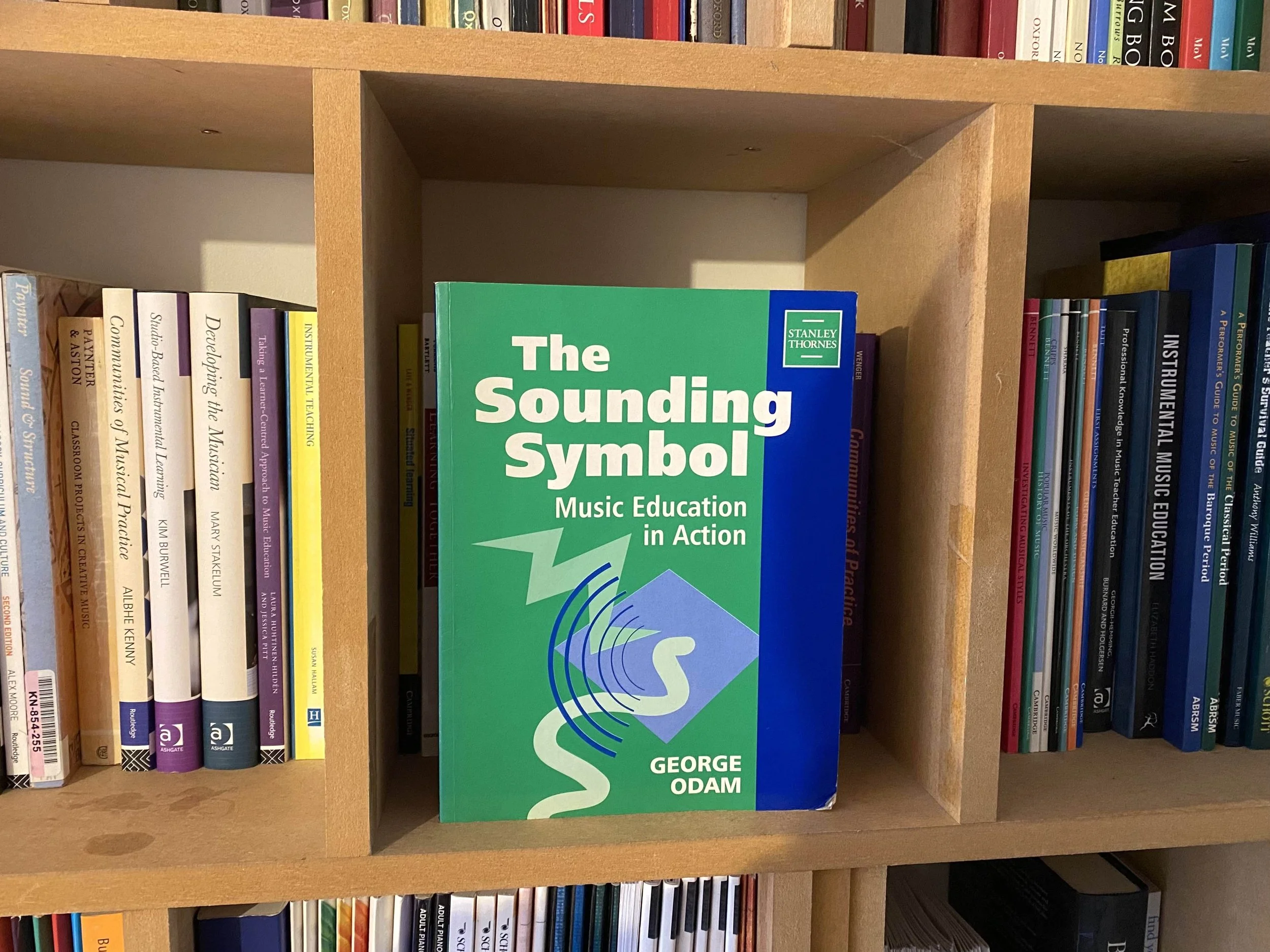
I hadn’t revisited the book for some years, and whilst I confess that I can't recall all its arguments in detail, I nevertheless remember how influential it was - and has thus remained.
For me, at that age, The Sounding Symbol offered a release.
Like so many of us, I was brought up learning an instrument from the score. Middle C was introduced on the piano at the first lesson, and so I progressed from there. Whilst I always - albeit unknowingly - enjoyed improvising on my own and making up my own tunes, it was very much about playing from the score. I'd always played by ear too. Nobody formally taught me how - it was simply part of the way I engaged with music.
But probably like you too, I'd grown up on a diet of ABRSM graded music exams in which achievement was largely measured by how successfully you could interpret and reproduce the notation on the page.
Reading music was fundamental, whilst playing by ear seemed to occupy a rather less prestigious position. We have all at one time or another been aware of the idea that one - reading or playing by ear - was somehow more legitimate than the other.
Odam's book encouraged me to think differently. It helped me look beyond the notation on the page and consider what it means to develop as a musician. I became increasingly interested in a more holistic approach to musical learning, exploring ideas associated with Dalcroze and Kodály, and thinking about the connections between listening, movement, singing, imagination, notation and practical music-making.
This video, which was originally broadcast on the much-missed Teachers’ TV was hugely influential too, and picked up on many of those ideas:
Sound before symbol, for as Odam writes:
‘When music learning has been most successful there is a fluent and effortless interaction between thinking, feeling and doing, and the sound and the symbol coalesce.’
The notes on the page represent music, but they aren't the music itself. Knowing what Middle C looks like on a stave is of limited value without an understanding of pitch, the ability to hear it and the experience of producing it.
That doesn't make notation any less valuable - quite the opposite. Reading music can open up new worlds of musical discovery and exploration, help us to recognise patterns and structures, and allow us to explore things we might never otherwise encounter. But its greatest value comes when we connect what we see with what we hear, understand and feel - they are inextricably linked.
And the relationship works both ways. Our aural skills can deepen our understanding of notation, just as notation can enrich our musical imaginations - The Sounding Symbol brought that to the fore. I’ve come to believe that these aren't competing approaches, but complementary ways of engaging with music.
After 25 years of teaching, I find myself returning to these ideas time and again. They underpin my teaching and impact my whole belief system around music and music education. Perhaps that's one of the things a really influential book can do: it gives us something to think about that continues to develop long after we've put it back on the bookshelves.
I need to get The Sounding Symbol off the bookshelf and read it again. I'm curious to discover what resonates most with me now, with a quarter of a century of teaching experience behind me, and how closely my recollections match the arguments I first encountered all those years ago.
But I suspect the central lesson will remain - our job as teachers isn't simply to help students reproduce the notes on a page, or to develop any one skill in isolation. It's to help them become thoughtful, confident and independent musicians - for they’re all travelling their own musical journey - equipped with a variety of ways to understand, explore and enjoy the music they make.
There's room for both, and perhaps, they're not nearly as separate as we sometimes imagine.
If this got you thinking…
If some of these questions have got you thinking about your own teaching, you might enjoy Letters for Your Musical Journey - my gentle weekly Monday email with a little encouragement, inspiration and space to reflect.
If this entry in The Notebook has encouraged or supported you, you are warmly invited to buy me a virtual coffee on Ko-Fi. Support starts from just £3 - whether as a simple one-off gift or a monthly subscription - helping this freely offered work to continue and quietly grow.





Perhaps that's one of the things a really influential book can do: it gives us something to think about that continues to develop long after we've put it back on the bookshelves.